By Radhika P Nair, 10 May 2026, 06:30 PM IST

SUMMARY
India is still a tiny market for Airbnb 15 years after setting up shop here. But it is among its fastest growing regions, with booking surging 50% for two quarters in a row, driven largely by domestic travellers.
When Rooma Sinha listed her studio apartment in Goa’s Arpora village on Airbnb two years ago, she wasn’t sure about how things would play out. Renting the apartment out would assure her of a steady income, but the Airbnb listing had the potential to help her earn much more. However, things were slow for many months after she listed on the alternative stay platform and the takings weren’t
enough to sustain her.
That changed last year.
“I saw bookings shoot up on Airbnb,” says Sinha, who resides in Bengaluru. Indeed, the apartment’s average occupancy had gone up to 80% and that gave her the confidence to go all in. “I quit my job at a financial firm last year and am focusing on my business fulltime.”
Sinha now manages three other properties under Airbnb’s co-host programme, where hosts manage properties on behalf of other home owners. She has also bought another studio apartment and expects it to go live on Airbnb in a couple of months. Currently, Sinha charges an average of ₹3,000 for a night’s stay at her Arpora flat, with the tariff going up during peak season. What’s interesting is that almost all of her guests are Indians. Sinha’s experience reflects a larger shift Airbnb has been preparing for over 15 long years. The company is moving from being an alternative option to becoming a mainstream accommodation platform for Indian travellers.

The big shift
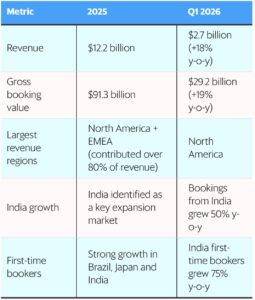
Airbnb was founded in 2008 by Brian Chesky, Joe Gebbia, and Nathan Blecharczyk. The idea had actually been conceived a year earlier, when Chesky and Gebbia, who were broke and looking to make some money, began renting out air mattresses in their apartment in San Francisco, leading to the name Air Bed and Breakfast. That handle was later shortened to Airbnb. Today, the platform connects people who want to rent out their homes or rooms in their homes with travellers looking for alternative or affordable accommodation. Since its humble beginnings, Airbnb has gone on to become a multinational with a presence in 220 countries and over 9 million active listings. In FY25, it recorded $12.2 billion in revenue and over $91 billion in Gross Booking Value \GBV] globally.
Growth velocity
Airbnb recorded strong revenue and GBV growth
across key markets in the first quarter of 2026.
Key details from Airbnb’s financials
Source: S&P Global and Airbnb Financials
In India, the company spent the initial years catering to people travelling abroad. Building supply was a secondary goal, meant to support the few international tourists who wanted an Airbnb experience in the country. But that thesis has completely changed
today. Indian travellers are now the company’s most important customers in the country.
Mixed bag
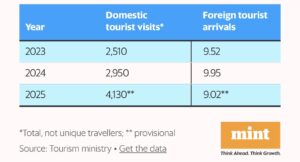
While domestic tourism is booming, inbound has
stagnated.
Tourist visits and arrivals in India (in million)
*Total, not unique travellers; ** provisional
Source: Tourism ministry
“Pre-pandemic, I would say that we were largely a global business. Most of our India play was when Indians were traveling
overseas and they would have a great experience there and come back and say, ‘Why can’t we do this here,’” says Amanpreet Singh Bajaj, Country Head for Airbnb India and Southeast Asia. The covid pandemic reversed that equation completely. “About 70% of bookings from India were done for international stays pre-pandemic. That’s overturned. In 2025, 80% of the bookings in India were domestic and this is a structural shift rather than a temporary one,” discloses Bajaj.

Amanpreet Singh Bajaj, Country Head of Airbnb India and Southeast Asia, highlights what he calls a structural shift: 80% of bookings in India are by domestic travellers today. Pre-covid, 70% of bookings from India were for international travel.
The shift has changed how Airbnb views India. In 2017, when co-founder and chief executive Chesky visited India, he called the country a “long-term bet”.
While Airbnb does not disclose India specific revenue or GBV figures, it has in recent years classified India, as a key
expansion market, along with Japan and Brazil. The company recorded a 10% yearon-year increase in total revenue in FY25, but over 80% of that revenue is concentrated in North America and the EMEA region, markets that are already reaching saturation point. The company is therefore looking at markets in the Asia Pacific and Latin America for growth. With good reason, as expansion markets are
seeing twice the growth rate in bookings compared to core markets.
In its just-announced Q1 2026 results, Airbnb disclosed that bookings from India saw a 50% increase year-on-year for the second quarter running, and first-time bookers grew 75% year-on-year, up from 60% the previous quarter.
A number of factors have come together to create this inflection point for Airbnb. As Bajaj says, Indians who experienced Airbnbs abroad wanted a similar experience back home. Take, for instance, 38-year-old Megha Sharma, a Bengalurubased IT professional, who first used Airbnb when she stayed with an elderly host in Bath during a girls’ trip to the UK in April 2018. “She packed lunch for us when we were heading out for a day trip without us asking,” Sharma recalls. “That stayed with me because it did not feel transactional.”
The same year, in August, she took her Bhopal-based parents to Wayanad in Kerala and opted to stay with a local couple at their Airbnb-listed home. “My parents had only ever stayed in hotels while travelling,” she says. “For them, a stay in the South is as unique as travelling abroad, and they loved the experience. My mom still talks about it.”
Then came the pandemic. While it initially sent shockwaves across the travel industry worldwide, it eventually acted as a boost for travel in general and Airbnb in particular. It is well documented how Indians began staying in villas or homestays to avoid crowds, and how everyone started travelling more in what got termed as ‘revenge travel’.
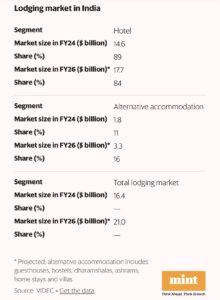
“Airbnb first inculcated the behaviour towards alternative stays in Indians and built the alternative accommodation market in India, so much so that it has become a verb,” says Virendra Jain, co-founder and chief executive at travel research firm VIDEC. The shortfall in hotel rooms, estimated at over 200,000 by the ministry of tourism, is contributing to the growth of this category.
The room shortfall boom
A shortfall in hotel rooms is propelling the growth of alternative accommodation in India.
Lodging market in India
* Projected; alternative accommodation includes
guesthouses, hostels, dharamshalas, ashrams,
home stays and villas
Source: VIDEC
Provisional data from the ministry of tourism shows India recorded over 4.13 billion domestic tourist visits in 2025. And around 14 million Indians travelled internationally purely for leisure in 2025. VIDEC data shows one in eight leisure travellers from metro and tier-1 cities is opting for alternative accommodation.
Market building
Ease of listing has played a key role in expanding supply in India. Bajaj says the platform has rolled out over 200 product updates to improve listing, discovery and payments. “For a host to list on Airbnb, it is like creating an Instagram or Facebook profile. It is user friendly,” says Rishi Modi, founder of Staymaster, which manages over 200 villas and apartments in Goa and uses Airbnb as one of its key distribution channels.
Sanjana Kapoor Arun, who runs La Maison Bougainvillea near Mahabalipuram, explicitly mentions a nearby highway so that guests arrive with the right expectations. “It is better that the listing is as accurate as possible,” says Arun, 37, whose property sees over 80% occupancy.

Trust in the platform is a big factor for hosts, as well. Sanjana Kapoor Arun’s Airbnb-listed villa near Mahabalipuram once saw a solo booking turn into a party of 25-30 people. Airbnb reimbursed her for the additional guests.
Hosts and guests say Airbnb’s trust and safety features have also strengthened confidence in the platform. Airbnb verifies IDs, allows hosts to communicate with guests before accepting bookings, and offers 24/7 support lines for users and even neighbours facing issues. Multiple hosts pointed to AirCover, Airbnb’s insurance and reimbursement programme for guests and hosts, as a key reassurance
mechanism.
Arun recalls how a guest who claimed he was travelling solo turned the quiet stay into a party for 25 to 30 people. Airbnb later reimbursed her for the additional guests. Another host says AirCover paid for 80% of the damages after a fire at a villa during a stay.
As listings have grown, a layer of professional operators has emerged around Airbnb’s ecosystem. Companies such as Staymaster, StayVista and Elivaas now manage, market and distribute villas on behalf of homeowners. In addition, the co-host programme allows experienced hosts such as Sinha and Arun to operate listings for other property owners. Hosts say success on Airbnb increasingly
depends on real-time price adjustments, high ratings, visibility and consistent guest experiences.
Demand-side shifts have also fuelled growth. Millennials and Gen Z travellers are travelling more frequently and increasingly seeking out unique or experience-led stays. Surveys by agencies such as Thomas Cook and Agoda show younger Indians are now taking etween four and six leisure trips annually, compared to one or two holidays earlier.
“Travel is increasingly becoming a form of
self-expression for younger travellers,” says Bajaj. “People are planning trips around things they care deeply about, whether it’s music, food, culture, sports or wellness.”
That shift is visible in how younger travellers use Airbnb. Riddhi Danani, a 24k year-old from Lucknow, says many of her recent bookings have revolved around concerts and group trips with friends. She recently stayed in Bandra \Mumbai) and Hauz Khas \Delhi) during trips planned around music events because she wanted to spend time exploring nearby cafes. “Airbnb was affordable and located close to the places we wanted to visit,” Danani says.
As experience-led travel is increasingly becoming the norm, Airbnb has redoubled its focus on this vertical. In 2025, the company relaunched Experiences—unique, host-led activities—globally as part of a broader push beyond accommodation. Bajaj says nearly 90% of Gen Z travellers are open to booking experiences on the platform.
Growing pains
But that doesn’t mean it’s all smooth sailing from here.
If the early struggle for Airbnb here was convincing travellers to try alternative accommodation, growing supply exponentially while maintaining quality and consistency is the challenge today.
“We will make sure that we have the right supply for all the right use cases at the right price points in all new destinations that people are going to,” says Bajaj.
But creating quality supply is neither easy nor straightforward. Unlike hotels, where inventory can expand through organized
chains and developers, Airbnb’s ecosystem depends on thousands of individual homeowners and hosts choosing to enter the market.
India has also taken longer to reach this level of maturity compared to some other markets. Public data sources put the number of listings in France, Airbnb’s second largest market after the US, at over a million, between eight and 10 times India’s 115,000. The company entered France the same year as India.
Moreover, there is already pushback in India over apartments being let out on Airbnb. Soraya Postel’s friend listed a room in her 10th floor terrace penthouse apartment in Mumbai 15 years ago as a gift to her. “It opened up the world to me,” says Postel, 67. But her apartment is in a cooperative housing society building and for six long years she faced issues with the society. “I am very tenacious, so eventually I convinced them and they gave me a noobjection certificate,” says Postel, who has hosted over 600 guests so far.

Soraya Postel has been letting out her Mumbai apartment to short term guests on Airbnb for the last 15 years. It took her six years to convince her cooperative housing society to give her a no-objection certificate for the business.
But not everyone has the same patience. Bengaluru-based Wilma Aranha stopped taking Airbnb bookings for her apartment in 2023 after two years and gave it out as a regular rental. “I had a great experience with Airbnb. I had really great guests. But one neighbour started creating problems asking why I wasn’t paying commercial maintenance,” recalls Aranha, 50, who stopped accepting bookings in 2025. In March, a Mumbai cooperative court ruled that housing societies can legally prohibit homeowners from hosting guests through
Airbnb in residential flats.
India is hardly unique in facing pushback against short-term rentals. Spain recently ordered the removal of over 65,000 holiday
rental listings amid concerns around housing affordability, while cities such as Athens have banned new short-term rental registrations.
The bigger challenge may lie in the size of the India opportunity. Indian travellers have clearly taken to Airbnb, but the country
remains a relatively small business for Airbnb globally. While the hospitality service does not disclose country-specific numbers, the company previously stated that India is not among its top 10 markets.
The low volume of inbound international travellers is also a cause for concern. Foreign tourist arrivals to India have stagnated between 9 million and 10 million annually since 2023. In contrast, tiny Vietnam recorded over 21 million foreign tourist arrivals, Japan over 42 million and South Korea almost 19 million arrivals in 2025.
This is a challenge for Airbnb. “Inbound tourism is still India’s weak spot. Domestic travel in India is massive, but inbound tourism has not scaled as many expected over the last decade,” says VIDEC’s Jain. “If you look at markets where alternative accommodation has become deeply entrenched, inbound tourism has played a very important role.”
However, domestic travel is considerably larger than international across all key markets, underscoring why Airbnb is razor focused on capturing local travellers in India.
“India not only has a large population, but it also has a very young one. So, the potential for growth is very high,” says Jain. “For platforms like Airbnb and Booking.com, India will remain the market to focus on for the next 10 years.”