Analysts say Gulf hubs will recover despite short-term drop in demand
Dhanusha Gokulan, Chief Reporter

Dubai: Airlines across the UAE and wider Gulf are steadily rebuilding operations, with flights resuming almost immediately after recent disruptions, signalling early resilience in one of the world’s most connected aviation hubs. An extraordinary 1.4 million passengers have been served through the UAE’s airports since the beginning of March.
UAE national airlines has also achieved 44.6 per cent operational recovery compared to previous operational levels. Around three weeks into the launch of Operation Epic Fury, a US-Israel-led military campaign in Iran, the region’s aviation sector is starting to show signs of stabilisation, even as the geopolitical situation remains fluid and a formal ceasefire has yet to emerge. UAE airlines Emirates and Etihad Airways have restarted flights on key routes, while others are operating via alternative routings to maintain connectivity with Europe, North America and regional destinations. Similarly, flydubai and Air Arabia have also brought back limited services across parts of Asia, Europe and the Middle East, signalling a cautious but steady rebuild. Just this morning (March 17), air traffic operations resumed to normal across the UAE’s airspace after authorities temporarily closed the country’s airspace as a precautionary measure, the General Civil Aviation Authority (GCAA) said. The resumption happened in a matter of hours. Operations also resumed quickly across several international and regional carriers. Qatar Airways is also operating special repatriation flights, and while Oman Air has cancelled flights to Dubai and Doha until the end of the month, most of its network is operating normally. Oman Air helped more than 97,000 passengers return home during the peak disruption period. Air India and Air India Express operated 24 flights to Jeddah and Muscat on March 9, while European and North American routes continued using alternative airspace. Safety is paramount. Abdulla bin Touq Al Marri, the Minister of Economy and Tourism and Chairman of the General Civil Aviation Authority, said, “Human safety remains the absolute priority in the UAE,” said the Minister. He added, “The aviation sector managed the phase with responsibility and high operational readiness while ensuring passenger safety and the continuity of operations.
Flights resumed quickly — a key resilience indicator
Analysts point to the speed of operational recovery as a crucial signal. Linus Benjamin Bauer, Founder of BAA & Partners – an aviation consultancy, said recovery is likely to happen in phases, “Short-haul and regional traffic could rebound within two to four weeks, as aircraft and crews are already positioned.” He added, “However, restoring full hub capacity and long-haul connectivity typically takes six to ten weeks, because airlines must rebuild schedules, reposition fleets, and restore confidence among regulators, partners and passengers.”
What does recovery look like?
Bauer said that three indicators will define recovery: “First, airlines moving from temporary or ‘exception’ schedules back to normal connection waves at Gulf hubs.” He also said, “Second, foreign airlines are resuming services to Dubai, Doha and Abu Dhabi without extended caveats. Third, stabilisation in fuel prices, insurance costs and airfares, which indicates the system is returning to normal operating conditions.”
Why Gulf hubs are expected to recover
Despite short-term disruption, analysts argue that the structural strength of Gulf aviation remains intact. Bauer said, “Globally, we may see some temporary route redesigns or frequency reductions… However, the structural role of Gulf hubs in global connectivity is unlikely to change permanently.” Meanwhile, Virendra Jain, co-founder and CEO at VIDEC Consultants, has a similar view and said, “There is simply no alternative to the firepower that the airlines here offer in terms of capacity.” He added that while near-term impact is significant, long-term recovery is expected: “We truly believe that in the long term, normalcy will fully prevail,” he said.
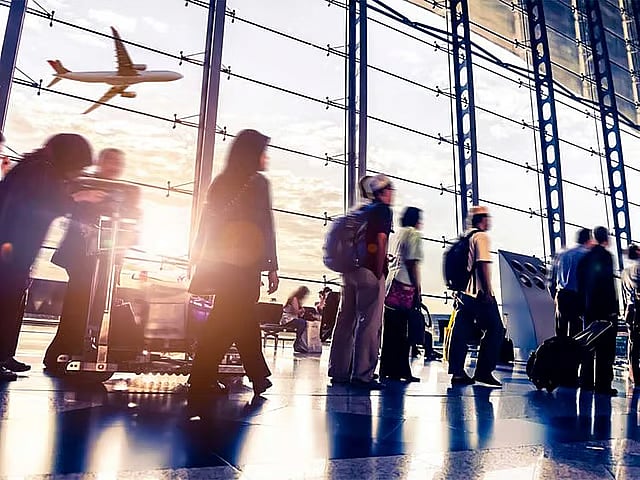
Demand dips, but recovery expected over time
Analysts say demand has not yet fully returned to pre-disruption levels, particularly for leisure and inbound travel. Jain noted that factors such as higher airfares, longer routes and geopolitical uncertainty are affecting short-term demand, while government advisories may impact inbound travel from Europe and the US.
At the same time, Bauer explained how travel demand typically returns:
“Travel demand usually returns in two phases. Essential travel and business trips recover quickly once operations stabilise, but leisure and transit demand take longer, because they depend heavily on confidence.” He added, “In the short term, some hesitation among transit passengers is normal. But historically, once operations normalise and media attention fades, passenger demand tends to rebound faster than expected.”